Cimba - Multithreaded Discrete Event Simulation
Cimba is a fast discrete event simulation library written in C and assembly, providing a process-oriented simulation worldview combined with multithreaded trial parallelism in a shared memory space for high performance on a modern desktop computer.
Parallelizing discrete event simulation is both a very hard and a trivially simple problem, depending on the way you look at it. Parallelizing a single simulation run is hard, since all events and processes inside the simulated world depend on a shared time variable and cannot race ahead. This requires complex coordination between the processing nodes to ensure that model causality is maintained. Tools for this exist, such as the Time Warp algorithm, but are mainly relevant for large-scale supercomputing, less so for a single workstation or compute server.
Luckily, we rarely want only a single simulation run, but rather a possibly large experiment consisting of many trials (replications and parameter combinations) to generate statistical results. These trials are intended to be independent, making them near-trivial to parallelize by simply running them all at the same time, or at least running as many as you have CPU cores available for.
Somewhat less trivially, we can also use the massive parallelism in today’s GPUs to calculate model physics. The key here is that we do not try to parallelize the simulation events from the event queue, since that is inherently serializing, but provide hooks for massively parallel GPU computation that is instantaneous in simulated time without affecting the event queue.
Taken together, Cimba provides a discrete event simulation engine that can utilize the considerable computing power in a modern multicore, GPU-equipped workstation for your research purposes.
As far as we know, there is no other tool that can provide this combination.
Main benefits of Cimba
It is powerful, fast, reliable, and free.
Powerful: Cimba provides a comprehensive toolkit for well-engineered discrete event simulation models, including very large ones, in a process-oriented worldview.
Cimba simulated processes are full asymmetric stackful coroutines. It is possible to pass control between processes at any depth of the call stack, not just from a single generator function. This enables well-structured coding of arbitrarily large simulation models. As a first-order object, a simulated process can be passed as an argument to other functions, returned from functions, and stored in data structures, allowing rich and complex interactions between processes.
Cimba provides pre-packaged process interaction mechanisms like resources, resource pools, buffers, object queues, priority queues, timeouts, and even condition variables where your simulated process can wait for arbitrarily complex conditions - anything you can express as a function returning a binary true or false result.
Cimba includes powerful logging and data collection features that makes it easy to get a model running and understand what is happening inside it, including custom asserts to pinpoint sources of errors.
Cimba includes a wide range of fast, high quality random number generators, both academically important and more empirically oriented types. Important distributions like normal and exponential are implemented by state-of-the-art ziggurat rejection sampling for speed and accuracy.
Cimba makes it easy to set up a proper experimental design as an array of trials, execute those in parallel, and calculate the necessary statistics, all in a single program.
As a C program, Cimba is easy to integrate with other libraries and programs. You can call CUDA routines for model physics or to enhance your simulation models with GPU-powered agentic behavior. You could even call the Cimba simulation engine from other programming languages, since the C calling convention is standard and well- documented for language bindings.
Fast: The speed from compiled C code and multithreaded parallel execution translates to high resolution in your simulation modelling. You can run hundreds of replications and parameter variations in just a few seconds, generating tight confidence intervals in your experiments and high density of data points along parameter variations.
In a M/M/1 queue benchmark, Cimba runs about 45-50 times faster than SimPy with all available cores in use. This corresponds to a 98 % reduction in run time.
In fact, Cimba runs twice as fast on a single CPU core (left chart, about 32 million events per second) than SimPy does with all 64 logical cores (right chart, about 16 million events per second).
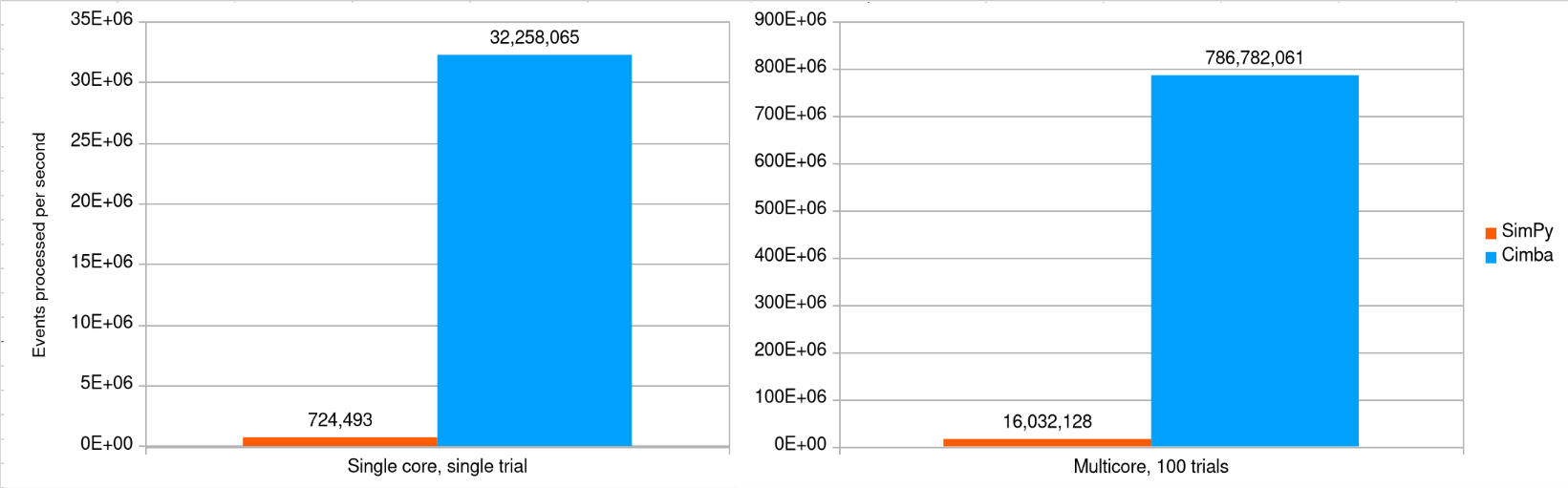
The reason for this speed difference is that a compiled program in C and hand-rolled assembly will always run faster than code that needs to be interpreted on-the-fly at runtime.
The CPU used here has 32 physical cores, running two threads per physical core. Cimba runs about 1 M events/second on a single core and about 25 M events/second/core on 32 physical cores for a scaling efficiency of 76 %. This also compares favorably to the literature on large-scale parallel discrete event simulation (PDES), where each simulation trial is distributed across many physical cores, where it seems that performance for the Time Warp-type PDES algorithms has leveled out at around 250 K events/second/core on massively parallel supercomputers.
Cimba runs two orders of magnitude faster than Time Warp PDES measured in events per second per core.
The reason is that keeping our entire event queue in “hot” CPU cache memory is orders of magnitude faster than communicating the same events across a link between separate devices, no matter how fast that link is.
Reliable: Cimba is well engineered, self-contained open source. There is no mystery to the results you get. The code is written with liberal use of assertions to enforce preconditions, invariants, and postconditions in each function. The assertions act as self-enforcing documentation on expected inputs and outputs from the functions. About 13 % of all code lines in the Cimba library are assertions.
There are unit tests for each module. Running the unit test battery in debug mode (all assertions active) verifies correct operation in great detail. You can do that by the one-liner
meson test -C buildfrom the terminal command line. Moreover, Cimba is compatible with sanitizers. A comprehensive test battery with ASan (address sanitizer), LSan (memory leak sanitizer), UBSan (undefined behavior sanitizer), and TSan (thread sanitizer) runs automatically on every push to the repo. Any issues surfaced are promptly fixed.Moreover, we have used the latest AI models (e.g., Claude Fable 5) for adversial code reviews, pinpointing even obscure errors that would be hard to find in traditional regression testing. For transparency, we publish these reviews in the repo, with follow-up reviews to verify that all issues are fixed.
Free: Cimba should fit well into the budget of most research groups.
Application areas for Cimba
It is a general purpose discrete event simulation library, in the spirit of a 21st century descendant of Simula67. It may be the right tool for the job if you need quantitative performance analysis of some system that is so complex that it is not possible to derive an analytical solution, but where the behavior and interactions of the constituent parts can be described in C code.
For example, you can use it to model:
computer networks,
hospital patient flows,
transportation networks,
operating system task scheduling,
manufacturing systems and job shops,
military command and control systems,
queuing systems like bank tellers and store checkouts,
urban systems like emergency services and garbage collection,
…and many other application domains along similar lines.
See the tutorials for illustrations of both expressive power and how to use it for multi-threaded computing power.
If you look under the hood, you will also find reusable internal components like stackful coroutines doing their own thing on thread-safe cactus stacks, fast memory pool allocators for generic small objects, and sophisticated data structures like hash-heaps combining a binary heap and an open addressing hash map with Fibonacci hashing for fast access to various objects.
Obtaining and installing Cimba
You simply clone the repository from https://github.com/ambonvik/cimba, build, and install it. You will need a C build chain and the Meson build manager. On Linux, you can use gcc or Clang, while the recommended approach on Windows is MinGW with its gcc compiler. For convenience, we use the CLion integrated development environment with built-in support for our build chain on both Linux and Windows.
See also the installation guide for a more detailed description.